New Insights Into Sports Injury Recovery
Shailer Park, Australia - June 18, 2026 / Essential Health Physiotherapy Shailer Park /
Recovery Expectations Matter
Returning to sport or physical activity after an injury can be a challenging process, particularly when recovery does not progress as quickly as anticipated. Many factors can influence healing timeframes, including the nature of the injury, individual circumstances, activity levels, and adherence to rehabilitation recommendations. Essential Health Physio is helping local residents better understand these considerations through an informative article exploring common questions surrounding recovery expectations. The resource outlines why timelines can differ from person to person and highlights the importance of appropriate guidance when returning to movement and sport. By sharing practical information and evidence-informed insights, the clinic aims to support informed decision-making for individuals managing Sports Injuries Shailer Park and seeking a clearer understanding of the recovery journey.
What Influences Sports Injury Recovery Timeframes
You rolled your ankle at Saturday morning football, or you felt something pull in your hamstring during a gym session. You’ve iced it, rested it, and now you’re wondering how long this is actually going to take. It’s the question almost every patient asks within the first minute of sitting down with a physio. The honest answer is that sports injury recovery doesn’t follow a single fixed timeline. It follows a pattern shaped by the type of injury, its severity, and what happens in the days and weeks after it occurs.
This article covers four of the most common sports injuries seen among active adults in Shailer Park, with realistic timeframes and the factors that genuinely influence whether recovery moves forward or stalls.
Why Recovery Timelines Are Harder to Pin Down Than You’d Think
Recovery timelines for sports injuries are ranges, not fixed numbers. Tissue healing is a biological process that varies significantly from person to person. Age, sleep quality, nutrition, training load before the injury, and how well you manage load in the immediate aftermath all shape how quickly you return to full function.
A 24-year-old AFL player and a 42-year-old recreational runner might sustain identical hamstring injuries and have recoveries that look nothing alike. Having a rough timeframe is still useful for planning, so here is what clinical experience and research suggest for the injuries most commonly managed at Essential Health Physio’s sports injury physiotherapy service.
Hamstring Strains: 6 to 12 Weeks
Hamstring strains are among the most common sports injuries in runners, AFL players, and anyone who sprints or kicks. The muscle group runs along the back of the thigh and is particularly vulnerable when asked to decelerate a fast-moving leg, something that happens repeatedly in field sports.
Grade 1 strains, where only a small number of muscle fibres are torn, often resolve in 6 to 8 weeks with appropriate rehabilitation. Grade 2 strains involving a more significant partial tear typically sit at the 8 to 12 week mark. A Grade 3 complete rupture can extend beyond 12 weeks and may require surgical assessment.
One of the strongest predictors of a longer recovery is returning to sprint-based activity before the muscle has rebuilt its load tolerance. Re-injured hamstrings consistently take longer to recover than the original injury, which makes patience a clinical recommendation rather than just common advice.
Runner’s Knee: 4 to 12 Weeks
Runner’s knee is a broad term for patellofemoral pain, where the kneecap doesn’t track correctly over the joint beneath it. It’s common in runners, cyclists, and gym-goers who do significant squatting or lunging volume.
The 4 to 12 week range is wide because patellofemoral pain responds differently depending on its underlying cause. In some presentations, hip weakness is allowing the femur to rotate inward under load. In others, foot mechanics or a spike in training volume are the primary drivers. Sometimes it’s a combination of both.
A running assessment or biomechanical assessment identifies which factors are contributing, which changes the recovery strategy considerably. Treating patellofemoral pain without understanding its cause tends to produce slow progress and recurring flare-ups rather than a clean recovery.
Ankle Sprains: 2 to 12 Weeks
Ankle sprains are graded from 1 to 3 based on the degree of ligament damage. A Grade 1 sprain with mild stretching and minimal swelling might have someone back on the court in 2 to 4 weeks. A Grade 3, where the ligament is completely torn, can require 8 to 12 weeks before return to sport is appropriate.
The phase of ankle recovery most people skip is proprioception training. Once swelling settles and pain eases, it’s easy to assume the ankle is ready. The ligaments and the surrounding nerves that feed positional information back to the brain need deliberate retraining after a sprain. Cutting this phase short is one of the main reasons the same ankle gets sprained again, sometimes repeatedly over years.
Strapping plays a practical role in both early management and the return-to-sport phase, providing external support while joint stability rebuilds.
Shin Splints: 3 to 12 Months
Shin splints, or medial tibial stress syndrome, sit at the longer end of the sports injury recovery spectrum and can be genuinely frustrating for people who are used to bouncing back quickly. The condition involves stress on the periosteum, the tissue surrounding the shin bone, and in some cases progresses to a stress fracture when training load isn’t reduced appropriately.
Mild cases caught early and managed with load reduction can resolve in 3 to 4 months. Cases where training continued through significant pain for an extended period tend to take considerably longer.
Running gait assessment is particularly relevant here. Overstriding, excessive heel striking, and poor hip control all increase tibial stress. Correcting these movement patterns is often the difference between a recovery that holds and one that cycles back around every training block.
What Actually Moves Recovery Forward
Physiotherapy for sports injuries goes beyond hands-on treatment, though that has its place. At Essential Health Physio, several specific approaches are used depending on the injury type and where someone is in their recovery.
Dry Needling
Dry needling targets trigger points in overloaded muscles, reducing tension and improving the muscle’s ability to participate in rehabilitation exercises. It tends to be most useful in hamstring and shin splint presentations where there is significant muscular guarding around the injury site.
Laser Therapy
Laser therapy supports tissue healing by increasing local circulation and reducing inflammation at the injury site. It’s most relevant in the earlier stages of recovery when tissue repair is the priority. Learn more about how laser therapy works as part of a structured recovery plan.
Biomechanical and Running Assessments
Understanding why an injury happened is as important as treating the injury itself. Biomechanical and running assessments identify the movement patterns contributing to ongoing tissue stress. This shapes both the treatment approach and the likelihood of re-injury once full activity resumes.
Strapping also features in ankle management specifically, offering external support during the return-to-sport phase while the joint is still building back its stability.
What Slows Sports Injury Recovery Down
The two most consistent factors that extend recovery timelines are returning to activity before the tissue is ready, and stopping rehabilitation once pain resolves rather than once capacity is fully restored.
Returning early is understandable. For active people, training is part of routine and identity, and time away feels like regression. The problem is that tissue healing has its own pace. Loading it before it is ready tends to extend total recovery time rather than compress it.
Stopping rehab when pain settles is the other side of the same issue. Pain going away does not mean the tissue has returned to full strength and load tolerance. The gap between those two points is where most re-injuries occur.
Sports Injury Recovery: Your Questions Answered
| Question | Answer |
|---|---|
| How long does sports injury recovery take? | Sports injury recovery time varies by injury type and severity. Minor ankle sprains can resolve in 2 to 4 weeks, runner’s knee in 4 to 12 weeks, hamstring strains in 6 to 12 weeks, and shin splints in 3 to 12 months. A physiotherapy assessment gives you a realistic, personalised timeline. |
| How long does a hamstring strain take to heal? | A hamstring strain typically takes 6 to 12 weeks to heal depending on its grade. Grade 1 strains with minor fibre tearing may resolve in 6 to 8 weeks, while Grade 2 partial tears often need 8 to 12 weeks. Returning to sprinting before full recovery is the most common cause of re-injury. |
| How long does runner’s knee take to recover? | Runner’s knee, or patellofemoral pain, generally takes 4 to 12 weeks to recover. The wide range reflects how differently this condition responds based on its underlying cause. A biomechanical or running assessment helps identify the contributing factors and shapes a more targeted recovery plan. |
| How long does an ankle sprain take to heal? | Ankle sprain recovery ranges from 2 to 12 weeks depending on the ligament damage grade. Grade 1 sprains with mild stretching may resolve in 2 to 4 weeks, while a Grade 3 complete tear can take up to 12 weeks. Proprioception retraining during rehab is critical for preventing repeat sprains. |
| How long do shin splints take to recover? | Shin splints typically take 3 to 12 months to fully recover. Mild cases caught early and managed with load reduction can resolve in 3 to 4 months. Cases where training continued through pain for an extended period take considerably longer and carry an elevated risk of stress fracture. |
Get an Accurate Sports Injury Recovery Timeline
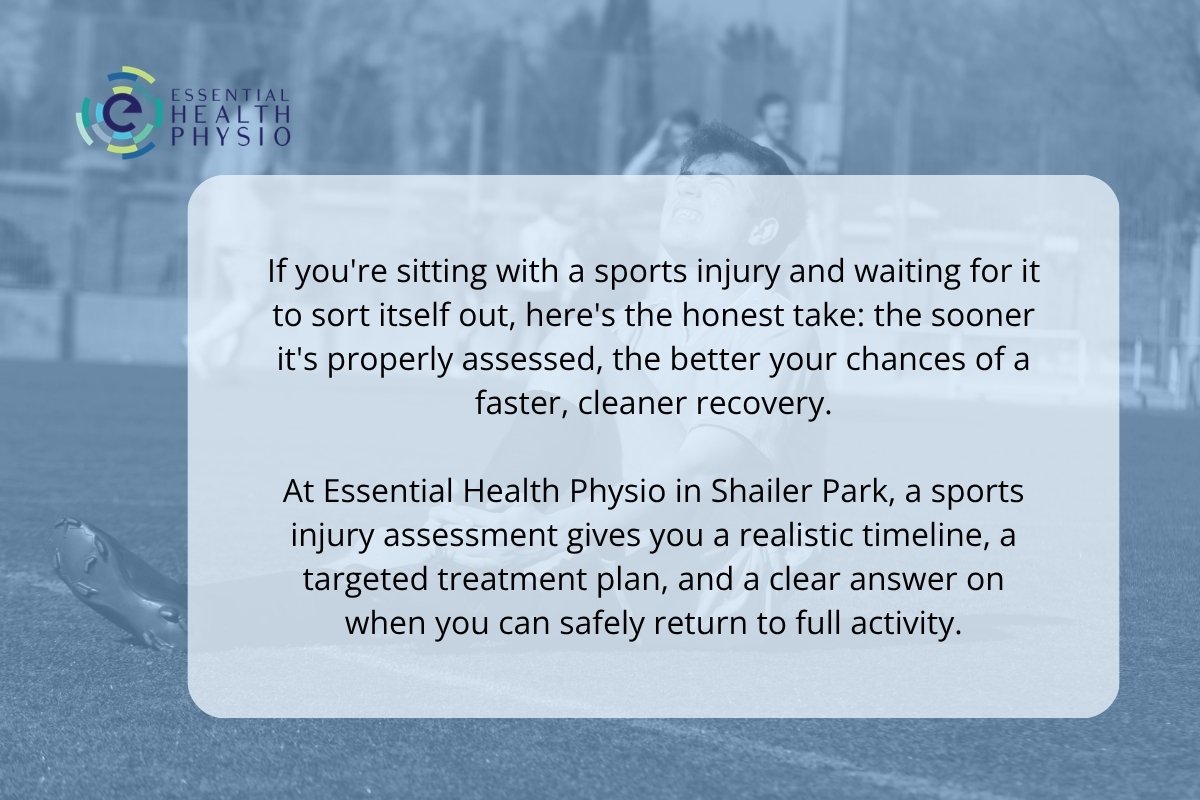
A recovery estimate given without a proper assessment is a guess. The real answer to how long your injury will take depends on what is actually happening, assessed properly and early. At Essential Health Physio in Shailer Park, an initial assessment gives you a realistic timeframe, a clear treatment plan, and a straight answer to the question you have had since the injury happened.
Supporting Your Return To Activity
 Shailer Park is a well-connected Logan suburb known for its parks, schools and community amenities. Essential Health Physio provides Physiotherapy services throughout Shailer Park and nearby suburbs.
Recovery from a sporting injury is often influenced by a range of factors, making it important to understand what may affect individual progress. Essential Health Physio provides assessments, rehabilitation guidance and physiotherapy services designed to support people throughout their recovery journey. Individuals looking for further information about Sports Injuries: How Long Should Recovery Actually Take? A Physio’s Honest Answer are encouraged to contact Essential Health Physio to arrange a consultation or discuss their circumstances with a physiotherapist. For those seeking support with Sports Injury Shailer Park, our clinic offers physiotherapy services aimed at helping people return to everyday activities and sport with greater confidence.


Contact Information:
Essential Health Physiotherapy Shailer Park
2/2 Bulwarna St, Shailer Park QLD 4128, Australia
Shailer Park, QLD 4128
Australia
Johnson Kwan
https://essentialhealthphysio.com.au/


Original Source: https://essentialhealthphysio.com.au/sports-injury-recovery-shailer-park/
